booklove

booklove
"The best children's stories are wisdom dipped in art and words." -Peter Reynolds

Saturday, April 12, 2014

First Big Book of the Ocean

First Big Book of the Ocean by Catherine D. Hughes was published in 2013 by the National Geographic Society. The book is split into sections for each of the oceans: Pacific, Atlantic, Indian, and Arctic, and includes animals found in that ocean. Some of the animals are likely to be very familiar to children such as the sea otter, walrus, and great white shark. But there are numerous less common animals as well that the children are bound to enjoy, such as the yellow-bellied sea snake, long-spine porcupinefish, and lion's mane jellyfish! The introduction page gives a sensational explanation on how to use the nonfiction text features in this book. Why don't all information children's books have this guide?!

The photographs are bright, lively, and beautiful! The backgrounds of each page are also bright and perfectly contrast the photographs. The font is black throughout the book but with lots of colored text boxes overlapping. There is a perfect, organized balance of text, color, and shape on every page. I didn't feel overstimulated at all!

At the end of the text there are Parent Tips for every parent including games and activities to conduct with their children. This is followed by a large, two-page spread of a world map. Each continent and ocean is labeled and there is a corresponding text box that identifies which animal lives in which ocean. The glossary and index are both very organized and child-friendly to manipulate. This nonfiction text could be easily enjoyed by all elementary aged children! Although the younger students will definitely need assistance decoding and comprehending some of the larger ocean specific vocabulary words.

On the back title page is the dedication of the book. Normally I wouldn't focus too much on the dedication but I found this one to be extremely touching and beautiful. It reads:
"Dedicated to Ana, Allison, Avielle, Benjamin, Caroline, Catherine, Charolette, Chase, Daniel, Dylan, Emilie, Grace, Jack, James, Jesse, Jessica, Josephine, Madeleine, Nash, and Olivia, the Sandy Hook Elementary School teachers and staff who bravely tried to protect them, and their loving families." Is that not cause enough to buy this book?


Friday, April 11, 2014

TIME For Kids: X Why Z?

TIME For Kids: X Why Z? was written by Mark Shulman and James Buckley Jr. in 2013 by Time Home Entertainment. It is an information book that answers a multitude of kids' most commonly asked random questions. To be honest, I learned A LOT from this book! It was fascinating!

The Table of Contents splits the book into seven main sections and colors entitled Human Body (pink), Animals (orange), Nature (green), Earth & Space (blue), Inventions (purple), Places (red), and History (brown). Once you turn the page into a section, the questions and facts are spread out in random areas. The question being answered is in bold font and color with the answer underneath. The facts are accurate and child-friendly which is sure to engage younger students of all ages. Additionally, each question and answer is accompanied with a real photograph that effectively corresponds to the text. There is also a "X Why Z? Fact" on almost every page that has a bonus interesting fact. For example, did you know walrus tusks can be three feet long? Me neither!

The photographs, fonts, and pages are all very vibrantly colored. The questions and answers are spread out enough on each page that they are still easy to read. There is a lot going on with each page visually and the reader will definitely be engaged. Also, the headings are very helpful in navigating around each section since one could get lost after a while. There is a small index in the back of the book that helps the reader with locating specific information and topics. I would recommend this book as an interesting read for second grade and above. I think all students would find X Why Z? fascinating and engaging, just like I did!


Tales of Famous Heroes

Tales of Famous Heroes by Peter and Connie Roop, and illustrated by Rebecca Zomchek, was published in 2010 by Scholastic Inc. This text is a collection of short biographies of famous heroes and their contributions to the world. The influential people featured includes: Paul Revere & Sybil Ludington, Sacagawea, Sojourner Truth, Frederick Douglass, Florence Nightingale, Mohandas Gandhi, Winston Churchill, Rosa Parks, Jonas Salk, Nelson Mandela, Neil Armstrong, Jane Goodall, The Tuskegee Airmen, Muhammad Ali, Billie Jean King, Sonia Sotomayor, and Barack Obama.

There is a Table of Contents in the beginning of the book that is very brief and simple to navigate. The title page for each person has a photograph or very realistic illustration pertaining to the person's life as the background. There is an illustrated portrait of the famous person in the foreground of the background. Each person is drawn with a "bobble-head" type head which makes them seem more child-friendly. On this same title page is the person's name in bold print, their dates of living, and an influential quote from that person. The historical information on each person is 3-5 pages long and very detailed, but in child-friendly terms. The biographies explain the person's childhood, family, personality and character traits, major events in their life, accomplishments, and contributions. There are also cartoon illustrations to coincide with the text that are labeled very nicely. The pages and illustrations are vibrantly colored and spark a reader's attention. This same pattern continues throughout the book and is very visually appealing and engaging. The index at the end of the book is very lengthy and helpful for any child searching for specific information.

Tales of Famous Heroes is very child-friendly and enthusiastic. I am not a history buff but the information about each person seems very accurate. Overall, I really enjoyed reading Tales of Famous Heroes and I think upper elementary students will as well. There were even a few people in this book that I'm embarrassed to say I had never heard of!


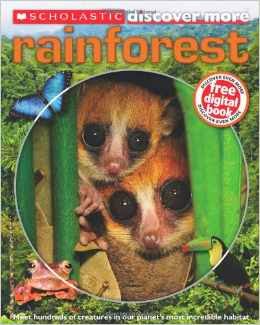
Rainforest

Rainforest by Penelope Arlon and Tory Gordon-Harris was newly published in 2013 by Scholastic Inc. It is an informational, nonfiction book that goes into great depth about the rainforest! This text is definitely for upper elementary students and above because of the level of complexity.

The Table of Contents lays out the topics/headings for each page in the beginning of the book.  The book is split into three major parts: All about rainforests, Rainforest animals, and The essential rainforest. Then once you turn to that page... wow, there is a lot going on here! The page is overwhelmed with beautiful photographs of real rainforest animals, landscape, plants, and people. The page numbers are clearly labeled and the titles are emphasized. There is also a great deal of nonfiction text features on each page including headings, text, interesting facts, text boxes, labels, definitions. There are some pages where the orientation of the book needs to change so one can read the page (Kids LOVE that!). I especially love that the last few pages are dedicated to saving the rainforests and encourage children to help. Afterward there is an in-depth glossary that is very child friendly and a very detailed index.

Rainforest does not follow a predictable pattern or layout but this does not make it harder to read. It actually makes it more fun! There is SO much visual information to process through the photographs and text that it is virtually impossible for a reader to get bored. Rainforest would be a great text for teaching nonfiction text features or even for students to use for independent research. I definitely recommend this nonfiction book for grades 3 and above as they will find it fascinating!


National Geographic Little Kids: African Animal Alphabet

National Geographic Little Kids: African Animal Alphabet by Beverly and Dereck Joubert was published in 2011 by National Geographic. It is an informational alphabet book about animals for young and elementary readers.

The Introduction page has a topographical map of Africa with a clear map key and labeled oceans. On the opposite page there is a paragraph introducing the book and encouraging the reader to join the authors on an alphabet safari. There is also a small photograph of the authors, Beverly and Dereck Joubert, on their own safari they experienced in Africa. The caption explains that they spent more than 25 years living with the wild animals of Africa. Wow, talk about credibility and authenticity on the topic!

Each page has a stunning, real photograph of the animal being discussed. It follows the typical pattern of: "A is for _____" for each letter, followed by a couple sentences of descriptions of that animal. There is also a small, colored "Did you know?" box on each page with a fascinating fact about that animal. For example, my favorite page is the "E is for Elephant" page since it is my favorite animal. It reads,

"E is for Elephant. A mother elephant and her elegant herd watch an energetic calf as he eagerly tries to stay just out of reach of his mom's elongated trunk."

Then the "Did you know?" fact reads: "Elephants weigh up to 14, 000 pounds and have more than 40,000 muscles in their trunks."

The photographs in this book are all vibrantly colored and make the reader feel like they are really on a safari! The page numbers are clearly labeled for easy reference. In the back of the book after the Z is for Zebra page is the "Animal Facts" pages. There is a small box for each letter and animal that was featured in the book, with more detailed facts about the animal. The facts include home, size, food, sounds, and babies. On the next page there is a very colorful and simple glossary featuring some of the more difficult vocabulary in the book. Lastly, there is a "More Information" page with additional books and websites that children and their parents can access to learn more about these African animals and more.

I absolutely adore this book! It is perfectly designed for young and elementary aged children. The pattern of the book is predictable and steady. The photographs and contents are brightly colored and very visually appealing. Overall, the nonfiction text features are simple and easily to use. The information isn't too complicated for a child to decipher and comprehend.  I could see a young child curling up with this book at bed time with their parents as well as an elementary aged student reading it during independent reading time.

Boy

Boy is the autobiography of Roald Dahl! It was published in 1984 by Heinemann and covers his life from birth until his first job working for Royal Dutch Shell. There is a second book that is a memoir, entitled Going Solo that picks up where Boy left off. Roald Dahl was one of my favorite authors as a little girl so naturally, I wanted to know about his life!

Roald Dahl had a more interesting life in his childhood than I have in my whole 25 years of living. I'm serious. This autobiography begins with the history of his family including his Uncle, Papa, mother, and five brothers and sisters in Wales. We then are introduced to Dahl's childhood from ages 6-7 in Kindergarten and then 7-9 at Llandaff Cathedral School in Wales. It is then that we hear the stories about the "Sweet Shop" with the nasty Mrs. Pratchett and his infamous "Great Mouse Plot." We also learn about the family vacations to Norway to visit family. In the next section entitled "St. Peter's," Dahl  is 9-13 years old and at boarding school. We hear stories of the terrible Headmaster, Matron (which reminded me very much of Matilda),  Captain Hardcastle, and Dahl's adventures in school. While there, he was actually in a brutal "motor-car" accident which sliced his nose almost clean off! The next section is entitled Repton and Shell where Dahl is ages 13-20. We follow him  as he goes to Repton "big school" and plays numerous sports (of which I've never before heard of). He also gets to be a taste tester for Cadbury chocolates (Pick me!) and gets the job of toilet seat warmer (No, thanks). I couldn't make this stuff up, right?! This all really happened to Roald Dahl. In the end of this book we learn that Dahl has gotten a job with the Shell Company and has made it as a businessman. At least for now...

Boy had me laughing at loud because of Dahl's hilarious recounting of his experiences. However, what I think I enjoyed the most was all the history and interesting facts about those times. Teachers used to "spank" children with canes?! No anesthesia for taking out tonsils and adenoids?! Outhouses?! The real photographs combined with Dahl's infamous sketches really were the icing on the cake. I was completely interested in the book at all times. No wonder he has been such a successful writer. If there is ever a fun autobiography to read, it's this one!

I have to say though, at first, I wondered how interesting Roald Dahl's life could really be. I was wrong! Boy is written with such humor and honesty that one can only expect from Roald Dahl. It was historically accurate and the technique of storytelling was fascinating for readers. I truly enjoyed reading about his life and I plan on reading Going Solo as well.


Earth to Clunk

Earth to Clunk was written by Pam Smallcomb and illustrated by Joe Berger. It was published in 2011 by The Penguin Group. It is a hilarious and light-hearted science fiction picture book that is sure to be a hit with young audiences. This is the story of a young boy who is given the writing assignment in class to write to his pen pal Clunk from the planet Quazar. At first, our young narrator is annoyed with the assignment and decides to send Clunk his big sister (hilarious). But in return, Clunk sent him a "Zoid," which is a weird dandelion-looking creature that follows him around. So, naturally, our friend sends Clunk his old dirty socks which is reciprocated by three "Forp" creatures. This pattern continues until one day his Mother says that he needs to get his sister back. Our narrator then realizes how much fun he is having with his alien pen pal. Just when he is afraid he will never hear from Clunk again, he visits for a sleep over. Oh, and the narrator's bossy big sister is returned, also. I guess being pen pals with an alien isn't so bad, after all.

This story line is sure to charm children of all ages. It was nice to read a science-fiction picture book that could easily be enjoyed by both boys and girls. The illustrations are bright and lively! They are full bleed and most span the full two pages. There is a lot going on each page that is sure to capture the attention and interest of young readers. The endpapers tell a short story all on their own also. Children will definitely love this short story of aliens, mischief, and fun!


This book serves not only as a funny science-fiction book also teaches important lessons for kids. The moral I received from the story was to always try new things because you could be pleasantly surprised. Perhaps you will even become best friends with an alien! I plan on reading this book to my second graders as soon as possible!