booklove

booklove
"The best children's stories are wisdom dipped in art and words." -Peter Reynolds
Showing posts with label Poetry. Show all posts

Saturday, April 12, 2014

When We Were Very Young

When We Were Very Young was written by A.A. Milne and illustrated by Ernest H. Shepard. It was first published in 1924 by Dutton Children's Books and then redesigned in 1988. It is a classic collection of children's poems. These poems were written for Milne's own son, named Christopher Robin Milne. Christopher Robin... sound familiar?! In the author's note entitled "Just Before We Begin," Milne explains that his son Christopher named a swan that he frequently feeds, Pooh. And so, the characters of Christopher Robin and Pooh (Bear) are born.

But now let's get to the poems! There is something special about poetry this beautiful and old-fashioned. They are silly and very child-centered. I can see children giggling away at these poems! The poems follow the little boy, Christopher Robin, through his childhood experiences and dreams. Milne's writing style has much repetition and rhythm that any reader will enjoy. The voice of the narrator in these poems is innocent and vulnerable, like a child.

My favorite poem of all from this collection is "Spring Morning." It is lengthy, but it is worth it! I love the descriptive language and how Milne perfectly describes the nature of a child. I admire the silliness with the underlying serious and philosophical undertones. The repetition of the beginning and ending lines is beautifully written and the rhyming is perfectly timed:

"Where am I going? I don't quite know.
Down to the stream where the king-cups grow--
Up on the hill where the pine-trees blow--
Anywhere, anywhere. I don't know.
Where am I going? The clouds sail by,
Little ones, baby ones, over the sky.
Where am I going? The shadows pass,
Little ones, baby ones, over the grass.
If you were a cloud, and sailed up there,
You'd sail on water as blue as air,
And you'd see me here in the fields and say:
'Doesn't the sky look green today?'
Where am I going? The high rocks call:
'It's awful fun to be born at all.'
Where am I going? The ring-doves coo:
'We do have beautiful things to do.'
If you were a bird, and lived on high,
You'd lean on the wind when the wind came by,
You'd say to the wind when it took you away:
'That's where I wanted to go today!'
Where am I going? I don't quite know.
What does it matter where people go?
Down to the wood where the blue-bells grow--
Anywhere, anywhere. I don't know."

The illustrations by Shepard are sketched with an ink pen. They are simple in concept but detailed in intricate design. There is at least one small picture to accompany each poem. These simple and child-centered illustrations are perfect for this traditional collection of poems for children. I think children of all ages will enjoy these poems but definitely with the company of an adult for the younger ones. The language is sophisticated for young children and therefore this would make a great read aloud or bed time story for them. But older elementary students, say second grade and above, should be able to read the poems independently. When We Were Very Young is traditionally classic and full of beautiful poetry; and I recommend it to children, parents, and teachers!


Joyful Noise

Joyful Noise: Poems for Two Voices by Paul Fleischman and illustrated by Eric Beddows, was published in 1988 by Harper & Row. It won the 1989 Newberry medal and is a lovely collection of poems about various insects. The poems go into great rhythmic detail about the insects' personalities, habits, and sounds.

There is a note in the beginning of the book that explains how the book is supposed to be read: "...by two readers at once, one taking the left-hand part, the other taking the right-hand part. The poems should be read from top to bottom, the two parts meshing as in a musical duet. When both readers have lines at the same horizontal level, those lines are to be spoken simultaneously." I very much appreciated this note and I'm sure young readers would as well! Without it, I'm not sure that I would have felt the full impact of Fleischman's beautiful poetry.

The poems in Joyful Noise are truly magical. Each poem sounds like a unique song; rhythmic and full of life. When the poems are read with another person, like they are supposed to be, they really blossom into the creative genius they are. My favorite poem of them all has to be "Fireflies." It is difficult for me to type up an excerpt of the poem when I feel in order to get the full effect, you need to hear it. This link will take you to a recording of a brother and sister reading Fleischman's "Fireflies" aloud: Click me!

There are also black and white charcoal pencil style insect drawings throughout the book that correspond to the poems. They are whimsical and full of character and excitement! The insects take on personalities and facial expressions of real people, which makes them very child-friendly.

Young readers of all ages will fall in love with Joyful Noise. It would make a wonderful bedtime story for parents and their children. It would also be excellent for practicing fluency in school. I am really looking forward to sharing this magical book with my second graders. They love participating in reader's theater scripts and fluency activities so I am positive they will be eager to practice with this work of art!


Dark Emperor

Dark Emperor and Other Poems of the Night was written by Joyce Sidman and illustrated by Rick Allen. It was published in 2010 by Houghton Mifflin Harcourt Publishing Company. It won the Newberry Honor for 2011! This text is a wonderful collection of twelve beautiful poems about night time animals for children.

The beginning end paper is a dark, eggplant purple reminiscent of the night. This is followed by a stunning two-page spread of a sunset landscape. Darkness is approaching! The first poem of the collection entitled Welcome to the Night where creatures of all sorts are welcomed into the wonderful world of darkness. The vivid poems that follow include diverse animals such as the snail, spider, and bat. Each poem tells the story of that animal during the night time. The "Dark Emperor" is symbolizing the enormous great-horned owl from the cover; who rules over the night. My favorite poem from the book is Oak After Dark because it reminds me of the giant trees at my childhood home. I used to fall asleep with my bedroom window open, listening to the giant trees. Sidman's use of rhythm and rhyme perfectly encompasses my memories:

"As nighttime rustles at my knee,
I stand in silent gravity
and quietly continue chores
of feeding leaves and sealing pores.
While beetles whisper in my bark,
while warblers roost in branches dark,
I stretch my roots into the hill
and slowly, slowly, drink my fill.
A thousand crickets scream my name,
yet I remain the same, the same.
I do not rest, I do not sleep,
and all my promises I keep:
to stand while all the seasons fly,
to anchor earth,
to touch the sky."

Each creature of the night has two different sections dedicated to them. The first is the detailed poem itself on the left. Then on the right of the second page is factual, in-depth information about the subject. I absolutely love this feature of the book because it not only teaches the reader about the specific aspect of the night but then deepens their understanding and complexity through the poem. Genius!


Following the final poem, there is another gorgeous, two spread landscape that now features the sun rising. The final end paper is a golden yellow which symbolizes the coming of day. All of these poems are suitable for elementary students of all ages. I think children will understand the poems independently but primary children may need the assistance of an adult for some of the multisyllabic and content specific words. The factual descriptions on the right side may also need to be further read and explained to the child depending on their ability. The subject matter of this text is interesting to children because they love animals! The poems evoke a feeling of mystery and excitement in the reader. Additionally, the language in the poems is absolutely beautiful and descriptive.

The illustrations are magnificently detailed and unlike any I have seen! They follow the nighttime theme of darkness and serenity but with pops of color. They are extremely textured by Allen's use of line, perspective, and shading.The illustrations were created by relief printing which is where a drawing is transferred onto wood, the drawing is cut and carved away, and the parts left uncut will be covered with ink and printed on paper. The title page says, "The prints for Dark Emperor were each printed from at least three blocks and then hand colored with a strongly pigmented watercolor called couache." The combination of rich poetry and intricate illustrations makes Dark Emperor must-have for every library!


Friday, April 11, 2014

Love That Dog: A Novel


Love That Dog: A Novel by Sharon Creech was published in 2001 by Harper Collins. It is a fictional novel in which a boy named Jack tells the story of his dog. He is studying poetry in Miss Stretchberry's class and the entire novel is written in short poems by Jack to his teacher.

I couldn't help but giggle to myself from the very first page. Our narrator, Jack, is writing to his teacher Miss Stretchberry through poems:
"September 13

I don't want to
because boys
don't write poetry.

Girls do."

Each entry written by Jack has the date and his thoughts as a poem. The text spans throughout the school year. He begins as a reluctant writer and doesn't have ideas for any poems. He struggles to understand the mentor poems in class. Yet as the text goes on we quickly see a change in Jack as he becomes more analytic and interested in the mentor texts. He even begins writing some of his own and Miss Stretchberry enjoys them so much she wants to share them with the class. Jack's reaction is one I can envision all young boys having:

October 4

Do you promise
not to read it
out loud?
Do you promise
not to put it
on the board?

I don't want to spoil it for you but Jack's poems begin to tell the story of a dog he had once and he gets really into writing poetry. He even begins to develop his own sense of voice:

"January 31

Yes
you can type up
what I wrote
about my yellow dog
but leave off the part
about the other dogs
getting killed dead
because that's too sad.

And don't put
my name
on it
please.

And maybe 
it would look good
on yellow paper. 

And maybe
the title
should be
YOU COME TOO."

Jack slowly becomes a wonderful poet and it is fascinating to see his skills and talent develop throughout the school year. He even becomes a huge fan of a famous poet named Mr. Walter Dean Meyers and gets him to visit the school! This book touched my heart in few ways as a teacher and dog lover myself. We get to witness this young boy blossom as a reader and writer of poetry in all aspects of the craft. If you love this book or are more of a "cat person," there is a sequel to this book entitled Hate That Cat: A Novel. I haven't read it yet but I definitely plan to!

I do have one, and only one, criticism of the text. I didn't like that copies of the mentor poems were provided at the end of the book instead of the beginning. I didn't know they were even there until I finished the book and found myself wishing I could refer to them throughout the story. My poetry unit for my second graders is beginning next week and I plan to read this book aloud to them. However, I will provide copies of the mentor poems from the back of the book for my students from the beginning so they can construct more meaning from the text.


Saturday, March 22, 2014

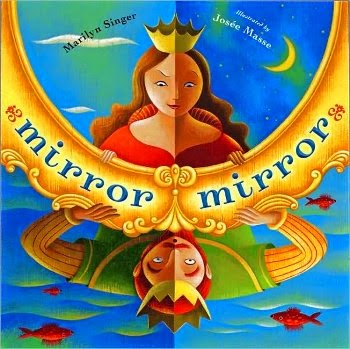
Mirror, Mirror: A Book of Reversible Verse

Mirror, Mirror: A Book of Reversible Verse was written by Marilyn Singer and illustrated by Josee Masse. Published in 2010 by The Penguin Group, Mirror, Mirror is a magical collection of children's fairy tale poems. It consists of 14 reversible fairy tale poems. One each page, there is a poem on one side and the same poem but backwards and with a completely new meaning! It is brilliant! The original poem is told from the protagonist's perspective. For example, in the poem the book is named after called Mirror, Mirror the actual poem is:

"Let me help you get some rest.
Mother knows best.
Listen to me,
Snow White.
Sleepy, Dopey, Happy,
you've been working day and night. 
You look worn out.
A long nap?
A blanket?
An apple to eat?
What would you like?
Time to get off your feet?"
And the reverse poem is:
"Time to get off your feet.
What would you like?
An apple to eat?
A blanket?
A long nap?
You look worn out.
You've been working day and night.
Sleepy, dopey, happy
Snow White,
listen to me.
Mother knows best.
Let me help you get some rest."

The reversed poems are from the perspective of the other character (usually the villain) in the story. The fairy tales are traditional and include Cinderella, Sleeping Beauty, Rapunzel, Little Red Riding Hood, Snow White, Jack and the Beanstalk, Hansel and Gretel, Rumpelstiltskin, The Frog Prince, and Beauty and the Beast. The illustrations are phenomenal! The pages are split in half to represent each poem respectively. The colors of the text are extremely bright and colorful. The pages are glossy and magical.They are full bleed and throw the reader right into the story. The use of line, contrast, and balance is absolutely perfect and every part of the illustration has meaning. 

We begin our poetry unit next month and I plan on reading this text to my second graders. I think they will be amazed by the craft of writing that Singer used and equally enthralled with the illustrations! I know that most of them would love to attempt to write their own reverse poem just for fun.