booklove

booklove
"The best children's stories are wisdom dipped in art and words." -Peter Reynolds
Showing posts with label Fiction. Show all posts

Friday, April 11, 2014

Love That Dog: A Novel


Love That Dog: A Novel by Sharon Creech was published in 2001 by Harper Collins. It is a fictional novel in which a boy named Jack tells the story of his dog. He is studying poetry in Miss Stretchberry's class and the entire novel is written in short poems by Jack to his teacher.

I couldn't help but giggle to myself from the very first page. Our narrator, Jack, is writing to his teacher Miss Stretchberry through poems:
"September 13

I don't want to
because boys
don't write poetry.

Girls do."

Each entry written by Jack has the date and his thoughts as a poem. The text spans throughout the school year. He begins as a reluctant writer and doesn't have ideas for any poems. He struggles to understand the mentor poems in class. Yet as the text goes on we quickly see a change in Jack as he becomes more analytic and interested in the mentor texts. He even begins writing some of his own and Miss Stretchberry enjoys them so much she wants to share them with the class. Jack's reaction is one I can envision all young boys having:

October 4

Do you promise
not to read it
out loud?
Do you promise
not to put it
on the board?

I don't want to spoil it for you but Jack's poems begin to tell the story of a dog he had once and he gets really into writing poetry. He even begins to develop his own sense of voice:

"January 31

Yes
you can type up
what I wrote
about my yellow dog
but leave off the part
about the other dogs
getting killed dead
because that's too sad.

And don't put
my name
on it
please.

And maybe 
it would look good
on yellow paper. 

And maybe
the title
should be
YOU COME TOO."

Jack slowly becomes a wonderful poet and it is fascinating to see his skills and talent develop throughout the school year. He even becomes a huge fan of a famous poet named Mr. Walter Dean Meyers and gets him to visit the school! This book touched my heart in few ways as a teacher and dog lover myself. We get to witness this young boy blossom as a reader and writer of poetry in all aspects of the craft. If you love this book or are more of a "cat person," there is a sequel to this book entitled Hate That Cat: A Novel. I haven't read it yet but I definitely plan to!

I do have one, and only one, criticism of the text. I didn't like that copies of the mentor poems were provided at the end of the book instead of the beginning. I didn't know they were even there until I finished the book and found myself wishing I could refer to them throughout the story. My poetry unit for my second graders is beginning next week and I plan to read this book aloud to them. However, I will provide copies of the mentor poems from the back of the book for my students from the beginning so they can construct more meaning from the text.


Sunday, March 23, 2014

The One and Only Ivan

The One and Only Ivan by Katherine Applegate is the first true children's novel I have read in a long time. It was published in 2012 by HarperCollins and won the Newberry Medal in 2012. This story was truly written for children and will elicit feelings from them that they may have never felt before.

The story follows Ivan; a Silverback gorilla who lives off of Exit 8 at the Big Top Mall and Video Arcade in a glass "domain." Ivan is a lonely, artistic gorilla who has many friends. He loves to draw and then eat his crayons afterward. One of his closest friends is an older elephant with motherly attributes and a bad foot injury. She "...remembers every moment since she was born: every scent, every sunset, every slight, every victory," (Applegate 53). Bob is another best friend of Ivan who is a small stray dog with a troubled past. He has a definite chip on his shoulders and enjoys sleeping on Ivan's belly. It is safe to say that the animals are unhappy going through their mundane lives of performing for humans and being stared at through glass.

Mack is the owner of the establishment and the only real father that Ivan has ever had even though he treats him badly. George is the custodian for the mall and has a daughter named Julia who loves Ivan as much as he loves her. She is a fellow artist and the two have an unbreakable connection. Julia accompanies her father to work and completes her homework while talking with the animals. One day, a new baby elephant named Ruby arrives to the shock of the other animals. Stella actually re-injures her foot trying to get Ruby out of the truck and welcomed into her new home. Stella quickly takes the role of mother on for Ruby as she settles into her home. Ruby is a naive, kind baby elephant that desperately misses her family. We find out that her family was slaughtered by humans. Sadly, Stella ends up passing away because of her foot injury and Mack's negligence to call a doctor. But before she dies she makes Ivan promise he will take care of Ruby and get her out of the mall and into a real home, like a zoo. The people and animals are obviously very saddened by their dear friend's death. Then Ivan decides to stop complaining and start doing something! Julia gives him finger paints and he begins making a puzzle that says "HOME" and painted a picture of a zoo. Julia picked up on the symbol after much huffing and puffing from Ivan and is amazed by his talents! She realizes that Ivan is trying to tell her that Ruby needs to go to the zoo. So, Julie and her father George hang up Ivan's paintings on the infamous billboard to attract more visitors. As visitors arrive, so does a news reporter and begins taking pictures of the establishment and treatment of the animals. Eventually the mall gets closed down (Yay!) and the animals will be transported to the zoo! They are very nervous but as soon as they arrive Ruby is put in with other elephants and Ivan with other gorillas. They are both very happy. Then one day Julia arrives to visit with Bob and her father and Ivan realizes that EVERYONE has a happy ending! He kept his promise to Stella, Ruby is safe, and he is finally the Silverback he always wanted to be.


The characters are lovable, sarcastic, and compelling. Children will fall in love with this story of friendship, hope, and being true to oneself. This book sheds light on animal cruelty and children will definitely feel empathy toward the animals. It will probably even make them cry! But as author Katherine Applegate said in her Newberry acceptance speech for this book, "Children know all about sadness. We can't hide it from them. We can only teach them how to cope with its inevitability, and to harness their imaginations in the search for joy and wonder," (Applegate). The One and Only Ivan does a wonderful job doing this.

There are some illustrations in the text also that are simple and charcoal reminiscent. The "chapters" are very short and the text is very spread out which is the perfect example of how one might imagine a gorilla speaks. I also enjoyed the author's note at the end of the book that explained the inspiration for the story. I think children would be equally fascinated to hear the explanation!


Fairly Fairy Tales

Fairly Fairy Tales by Esme Raji Codell and illustrated by Elisa Chavarri was published in 2011 by Aladdin. This book is unlike any I have ever read! It is a collection of very short fairy tales. It begins with a boy asking his mother to read fairy tales aloud to him before bed. Then the book goes into a checklist pattern where one can tell the pair is reading the regular fairy tale. They mention three parts that are usually part of the fairy tale and always answer "Yes." as in yes, that is included in the story. But then at the end of the pattern the child asks about something silly and modern that is not usually part of the tale. Then they say "NOOOO!" but on the next page the text reads, "Well, maybe." and there are beautiful, two page spreads of what could have been in the modern fairy tale. The tales included in this collection are The Three Little Pigs, Little Red Riding Hood, Jack and the Beanstalk, Cinderella, Hansel and Gretel, and finally Goldilocks and the Three Bears. At the end of the story the mother says it is bedtime and the boy falls asleep.


The endpages are bright lime green and it really energizes the reader for what is to come. The background on the pages is a simple white which helps the reader focus on the whimsical illustrations. The illustrations are very traditional in design but the colors are extremely bright and energizing. I really enjoy how Chavarri perfectly balanced a simple background with intricate illustrations. Children, parents, and teachers will enjoy making inferences from the busy illustrations. One of my favorite parts about this book is the back inside flap where the biography of the author and illustrator are shown. Instead of real photographs they are shown in cartoon form. How kid friendly is that?! I love it.


This is an excellent fairy tale collection book for children who have heard all the original fairy tales. It is a wonderful read aloud book for parents to read with their children before bed time. This book would be excellent for making inferences and rewriting fairy tales in school. It is an easy read and young readers of all ages would really enjoy it! Fairly Fairy Tales is a light and interactive read that should be part of any fairy tale collection.

Saturday, March 1, 2014

Extra Yarn


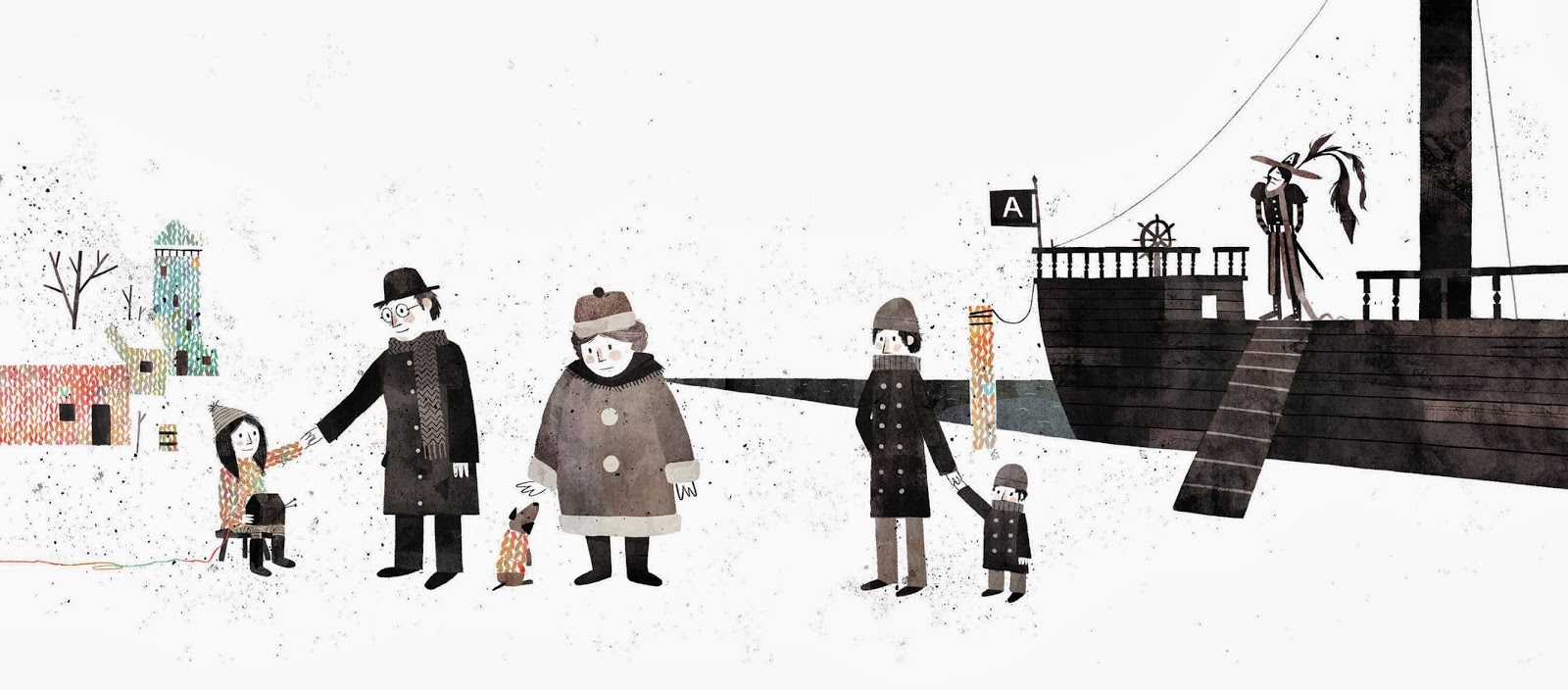
Extra Yarn was written by Mac Barnett and illustrated by the extremely talented, Jon Klassen. It is a Caldecott Honor Book. Published in 2012, Extra Yarn is a tale about a young girl named Annabelle who lives in a colorless town of black and white. One day she discovers a box with yarn of every color. She knits herself and her dog beautiful sweaters and amazingly still had extra yarn. As she walked through the town and went from place to place; people would make fun of her for being different with her colored sweater. But then she started to knit sweaters for many people and animals in the town and they loved it! Most miraculously though, the girl NEVER ran out of yarn! It was special, magical yarn. Before long, the quaint little town was extremely colorful and news spread fast about this yarn’s special powers. Then, an archduke arrived on his ship and tried to buy the yarn from Annabelle but she wouldn't have it! He offered her millions and she just said, “I won’t sell the yarn.” But that night the archduke hired three robbers to steal the box of yarn from Annabelle’s house. When the box made its way back to him, he opened it, and to his surprise there was no yarn! He cursed Annabelle’s family and said that she would never be happy again! The archduke threw the box overboard and it safely made its way back to Annabelle. On the last page, we see Annabelle sitting on a tree that is completely covered in yarn! Her box is next to her and we can only assume that although there was no yarn for the archduke; there will always be yarn for Annabelle. Her optimism and hope saved the day!

To be honest, I wasn't a fan of the ending with the archduke. I thought the story was great before he was introduced and that the ending could have been when we saw how colorful the town had become. I didn't feel like the problem with the archduke went well with the story at that point in the book. Maybe if it was a different type of character that was a bit more logical and not so fantasy-like. But I have a feeling that children LOVE the archduke part. I will read this book to my students this week and see what they think. Perhaps I just don’t have the imagination that I used to as a child!


The cover of the text is mostly white with the title spelled out in multicolored yarn. We see Annabelle leaning against the “T” with her multicolored sweater on and surrounded by animals in their sweaters. The backgrounds of the pages are purposefully very monochromatic to emphasize the colors of the yarn. The skin on all the people is extremely white and they all have dark black hair. The only pages with a dark background are the ones with the archduke; probably to emphasize that he is the villain of the story. Although I agree that the illustrations fit very well with the story, they are not my favorite illustrations. I think I still have a sour taste in my mouth from the archduke character being thrown into the story. I just wasn't impressed.
All in all, Extra Yarn is a sweet, creative story about imagination, hope, and optimism. The world can be whatever you want it to be if you are optimistic enough. I will update this post with my students' reactions to this story!

*UPDATE: I read this book to my second graders and they absolutely loved it! ESPECIALLY the ending with the arch duke! They mentioned that they actually wished he was in the story more than just the ending. I had a feeling they would really enjoy it. I think I need to remember there is a difference between reading children's literature as an adult and reading it as a child!

Exclamation Mark

Exclamation Mark was written by Amy Krouse Rosenthal and Tom Lichtenheld. Published in 2013, this book is about an exclamation mark on the path of self-discovery. He first encounters periods and tries so hard to be like the other periods but the more he pretends to be like everyone else, the more he feels confused and unfulfilled. Until one day he meets a question mark who, understandably, asks a LOT of questions! This completely confuses exclamation mark who ends up becoming very annoyed with all the questioning and yells, “STOP!” This surprised both the question mark and the exclamation mark. So then question mark asks, "How'd you do that? Can you do it again?" Exclamation mark takes off with sentences that are true to himself:

"Hi! Howdy! Wow! Yippee! This is fun! Way to go! Bravo! You're it! Yes! Home run! Cool! Congratulations! Happy Birthday! Yum! Encore! Go! That's great! Look out! Wake up! Thanks! Boo!"

Exclamation mark is so elated by this new discovery that he goes to show off his abilities to the periods and they are just as excited and happy for him as he is. This simple and sweet story teaches the lesson of being yourself in celebrating your uniqueness. You will be happiest and most fulfilled with you are true to yourself!
The design of this book is actually quite simple.  The dust jacket is a golden yellow with a smiling exclamation mark in the center. The end papers are a solid, deep burgundy color and I am not sure the reason for that color choice. The pages of the book mimic primary, lined writing paper which gives the story a very academic, child-centered theme. I enjoy the simplicity of the cover and illustrations and it works perfectly with the story line. 
As a second grade teacher, I plan on reading this book to my students for a writing lesson on using punctuation. Although this text would also be excellent to use as a reading fluency mini-lesson read aloud for reading the punctuation.  I have found that my class this year are very fluent as a whole but are still struggling to remember to use the proper punctuation at the end of their sentences. 


Saturday, February 22, 2014

Pancho Rabbit and the Coyote: A Migrant's Tale

Published in 2013, Pancho Rabbit and the Coyote: A Migrant's Tale was written and illustrated by Duncan Tonatiuh. It is a 2014 Author Honor book of the Pura Belpre award. Tonatiuh himself was born in Mexico City and grew up in San Miguel de Allende, Mexico. This book beautifully represents the Mexican culture.

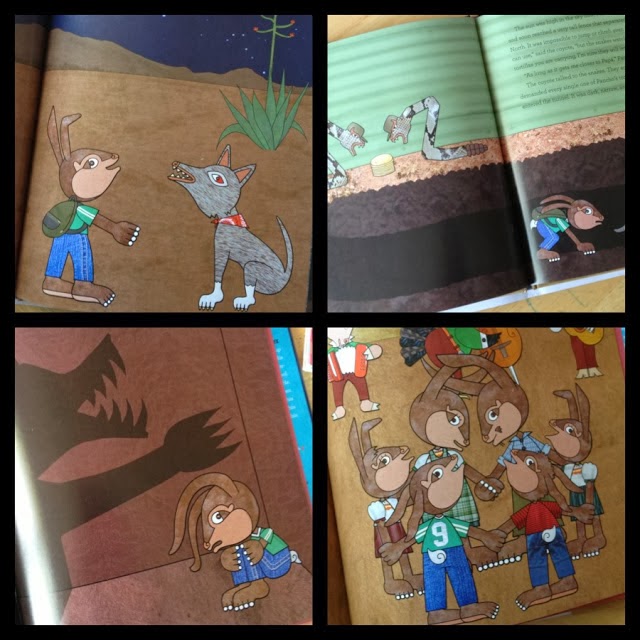
The story is about a family of rabbits who live in Mexico. Papa Rabbit and a few other animals left two years ago to go north for work to support their families. After the father is gone for quite a long time and misses his coming home party, Panco Rabbit decides to go searching for his father and brings his favorite meal: mole, rice and beans, warm tortillas, and fresh aguamiel. However on his journey he runs into Senor Coyote who says he will show Pancho the short cut if he gives him some of his mole. Desperate to see his father, Pancho agrees and leaves with the coyote. On their journey, Pancho and the Coyote endure many dangerous situations such as riding on top of a train, swimming across the river, and crawling through tunnels guarded by snakes. To get past each challenge, the coyote requests more and more of Pancho's meal for his father which he sadly gives up in desperation. By the time they finally reach "El Norte," Senor Coyote asks Pancho for more of his food but Pancho says he has taken it all and there is none left. "In that case, I will roast you in the fire and eat you!" Pancho (and the reader) are terrified but just when we thought all was lost, Papa Rabbit bursts through the door, scares off Coyote and saves Pancho! The boys return home to Mexico and the family agrees that next time they all will travel together.

There is a great deal of Spanish vocabulary in this book which really adds to the Hispanic theme.The definition of each word in English can be found conveniently in the Glossary in the back of the book. The author's note is absolutely fascinating. Tonatiuh goes into extensive detail about the symbolism and background information for the book. He also discusses his personal history growing up in Mexico and goes into detail about illegal immigration in the United States. He explains a number of fascinating points:

"In Spanish the word coyote has two meanings. It is the name of an animal, but it is also slang for a person who smuggles people between the U.S. and Mexican border."

"When they [his friends] returned to Mexico they told stories about eating snake when they ran out of food while crossing the desert, or of waiting for days in a shanty house in a border town for the coyote to show up."

"Furthermore, there are an estimated 1.5 million undocumented children in the U.S. and according to a 2011 Pew Hispanic Center report, in 2008 there were 5.5 million children of illegal immigrants in U.S. schools. I think that a lot of those children will relate to Pancho Rabbit." 

Isn't this the point of diverse children's literature? To have all children represented in books they can read? Reading this Author's Note adds a whole new level of understanding to the text. I don't think the text would be as meaningful and beautiful without hearing his story. The illustrations are equally heart warming. The background colors are duller with a lot of browns, oranges, and shades of the desert. The characters are in brighter colors of blues, greens, reds, and oranges. The earthy toned background with the contrast of bright characters is stunning. Tonatiuh explained on the Glossary page that he first hand drew the pictures and then collaged them digitally. They definitely represent the Mexican culture beautifully and perfectly fit with the story. Portraying the characters as cute animals is more child friendly for such a serious topic as illegal immigration. I know that my second graders will love this book and appreciate the background history. I cannot wait to share it with them!


Matilda

Matilda written by Roald Dahl and narrated by Kate Winslet was a 2014 Odyssey Honor book for the best audio book. It is 4 hours and 30 minutes long on 4 CD-roms. It was released in 2013 by Penguin Audio. I have never listened to an audio book before and I was afraid that I would not be a fan but I was pleasantly surprised! This rendition of Matilda is incredible.

Matilda is about a gifted five year old girl who lives with her nasty, crook parents who do not appreciate her and her extraordinary talents. She begins school where she is quickly identified as an exceptionally bright child by her sweet, young teacher Miss Honey. The head mistress of the school is the abusive, cruel woman Miss Trunchbull who makes every day absolutely miserable for Matilda, Miss Honey (her niece), and the students of the school. Matilda soon discovers she has magic powers and can make the evil Miss Trunchbull  and her parents pay for their unkindness. In the end, Miss Honey is able to adopt Matilda while Matilda's parents skip town as thieves and Miss Trunchbull disappears.

I have read the book Matilda and seen the movie before so while listening to this audio book I already knew what was going to happen in the story. However, listening to the story as an audio book was a completely new experience for me. The story really came alive! Oh, how I missed being read aloud to. Kate Winslet gives a groundbreaking performance narrating this text. She is able to portray every character int he story absolutely flawlessly. Her English accent is impeccable and made me see Matilda in a completely new light. I highly recommend this audio book for children and adults alike. I am a new huge fan of audio books and I am on my way to the library now to check out some more! Harry Potter audio book, anyone?

Sunday, February 9, 2014

Niño Wrestles the World

Nino Wrestles the World by Yuyi Morales is one of a kind. It was published in 2013 and won the Pura Belpre Illustrator award for 2014. It celebrates the Spanish American heritage in an adorable children’s story. This book is about Nino; the lucha libre mini-wrestler in his undies that takes down all competition! The story begins on the inside of the front cover where we are introduced to Nino's competitors. The energy of this book is loud and proud! The coloring is bright with mostly shades of red, blue, and yellow.

I cannot express the level of happiness I feel when I read this book. The energy is so positive and playful. The book begins with Nino playing with his toys in his bedroom when suddenly, the Nino wrestling show begins! Nino puts on his red mask and wrestles his enemies until he wins. He always wins! That is, until his two little sisters wake up and become his next competitors… to which he is no match! It is a sweet ending to an even more adorable book. The “fight scenes” are reminiscent of comic book style but even more fun! The book is filled with simple words in Spanish and the hectic lucha libre wrestling madness that normally ensues. On the last page, Morales explains lucha libre in more detail for the readers.


It was refreshing to read a book with Latino characters  and Spanish! This book is sure to be a hit with my second graders; especially the boys. You do not need to know anything about lucha libre wrestling to be a lover of this book. It will surely touch your heart! I am embarrassed to say I have not exposed my second graders to enough Latino/Latina literature. It is difficult to find! This book will now belong in my classroom library for all of my students to read. If you end up LOVING this book as much as myself and want more, check out Danielle Davis' blog for creative craft ideas that relate to the story. Enjoy!


Monday, February 3, 2014

Sidewalk Circus

Sidewalk Circus was published in 2004 and was written by Paul Fleischman and illustrated by Kevin Hawkes. This book is proof that sometimes actions speak louder than words. This wordless picture book conveys a storyline where ordinary people on the street parallel circus characters in the eyes of children.  I absolutely loved this book! Ok, I know what you’re thinking. What book don’t I like? I can’t think of one!

Since I knew this was a wordless picture book, I decided to really take my time reading it. If there is no text to convey the story then the pictures must be pretty intricate and telling, right?! There is a great deal of intricate details in the pictures of this book. The first thing I noticed that caught my eye on the front and back of the book was how the shadow did not match up with the characters. The shadows told a different story! Those are not regular working class people on the sidewalk… it’s a circus!

My favorite page in the whole book is the first two page spread. My eyes immediately were drawn to a little girl in yellow. Her bright yellow shirt popped against the dark shadow of a building and the monotony of adults. Then my next thought was, what is she looking at? This brings me to my next point. The illustrations are brilliant and absolutely beautiful in this book! The straight shadow line points our eyes directly at a construction man in overalls. Only, the little girl isn’t really looking at that man. She is looking at his shadow and imagining him instead as the circus ringleader like on the cover. But if you look at the shadows of the other working people in this picture they all have their own, normal shadows. It was like Fleischman and Hawkes were giving his a sneak peek at the excitement to come. Lastly, another reason this is my favorite part is because of the elderly woman sitting on the bench. I saw her as a preview for what is to come for this little girl. Too soon her childhood will be gone and her imagination with it. On this sidewalk, only children get to see the circus act.

As the book continues, this same little girl sits on the park bench surrounded by working class adults who are busy drinking coffee, reading their newspapers, or grumbling. They are all in black and white colors while the girl is in full color. As she sits on that bench and waits for her bus, the sidewalk of this street comes to life as a circus. On the second two-page spread we see an old theater with the sign, “WORLD-RENOWNED GARIBALDI CIRCUS!!! COMING SOON!” As she sits each working person across the street becomes a circus performer in her mind. There are the tight rope walkers, the strong man, the clowns, the juggling act, the daring sword swallowers, stilt walkers, and even the flying trapeze. What an imagination she has! But sadly, her bus arrives and she gets up to get on board.  Suddenly the adults become back in color as they board the bus showing that her child-like imagination was coming to an end now as she was pulled back to the real world. In the background we see a boy walking up the street in the same way the little girl did. He too sees the sidewalk circus! And so it continues!

I cannot say enough about the illustrations. The colors are soft with varying shades of dark and light. The textures are incredibly real looking. The shadowing is deliberate and does a perfect job drawing the eyes to certain parts of the page. The use of line in this book is magnificent and they go in all directions. My mind was never bored “reading” the pictures of this story. I would love to read this book to my second graders and watch the story come alive from their eyes. I am interested in reading more wordless picture books! Do any teachers out there have suggestions for me?  Check out this book from a library near you!


Friday, January 31, 2014

Babymouse: Queen of the World!


Introducing…. BABYMOUSE: QUEEN OF THE WORLD! Ok, not really. But she sure wishes! Babymouse: Queen of the World is an entertaining graphic novel by siblings Jennifer L. Holm and Matthew Holm. It is the first of the series and was published in 2005.

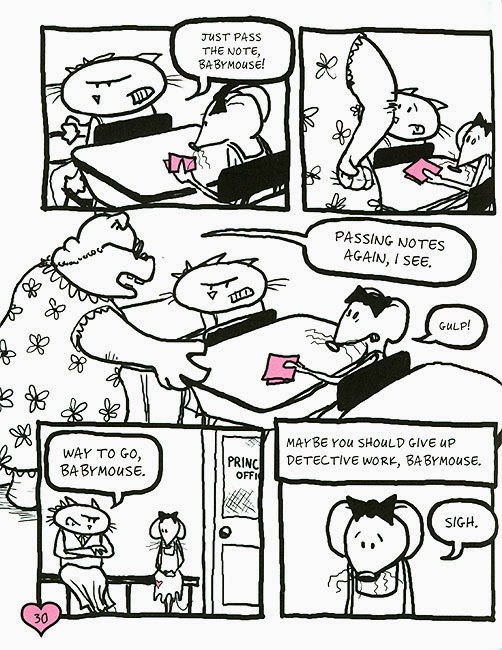
Babymouse is about a creative, sassy girl mouse enduring the typical issues of adolescence. She wants so badly to fit in with her peers, particularly the most popular girl named Felicia Furrypaws. Babymouse has a childhood best friend named Wilson the weasel and they have a lot in common. One day, Babymouse discovers that Felicia is having a sleepover and it seems that most girls in her grade are invited. except Babymouse! She is obviously devastated and has multiple (and hilarious) daydream adventures about the issue. The opportunity arises for Babymouse to get invited to Felicia’s party when she is asked to give Felicia her book report that is due that day in return for an invite. Babymouse quickly jumps at the chance and doesn’t look back which in turn makes her forget that she already had plans that same evening with Wilson. Babymouse remembered her plans with Wilson later on but decided to go on with her popular girl sleepover anyway. However, at the sleepover Babymouse discovers that she is not interested in the same things as these popular girls and doesn’t have fun. In the end, Babymouse heads over to Wilson’s house to watch a movie like originally planned!

Finally, a graphic novel series for girls! This text is full of excitement and hilarity. It is sure to be a hit among young girls due to the pink theme, hearts, and relatable adolescent storyline. The illustrations are simple but with the right amount of details. I especially enjoyed all of the creative daydreams that Babymouse had in the text. They regularly included her as a hero protagonist and were a riot! These daydreams were illustrated with a predominant black background which made them easy to differentiate from the actual story line. However, I do wish there was a bit more color instead of just black, white, and pink but that may just be the artist in me.  As a teacher, I believe this series will be a big hit with my second graders, particularly the girls. I am going to conduct a book talk with them about this book on Monday and gauge their responses. I am always trying to expose them to new genres and I have not seen my students read this series yet.
 My favorite part of this graphic novel other than Babymouse’s hilarious and sassy personality is the message behind it. The message in this book is clear: stay true to who you are! Trying to be like everyone else will not make for a happy life. Trust your instincts, love your friends, and celebrate yourself! 

               If you would like to check out this book for FREE at your local library, go ahead and click the "Image Source and Find a Copy!" link at the bottom of this post.


Image Source and Find a Copy!
Image 2 Source

Wednesday, January 29, 2014

Dog Heaven


Calling all dog lovers! Dog Heaven by Cynthia Rylant is not to be skipped over! If you have ever loved a dog, you will surely be touched by this story.  As a dog lover myself, I cannot say enough positive things about this book. This book is about the Dog Heaven that all dogs are fortunate enough to visit when they leave our world.

First of all, let me discuss the illustrations with you. They were painted using acrylics by Rylant herself and they are clearly directed toward her child audience. The contrast in colors is bight and drastic which really makes the pages come to life. The landscapes, people, and even animals are drawn as if a child had drawn them. That makes complete sense to me. Shouldn’t a real children’s book have illustrations that are (or look like they are) drawn by children? They are simple by design with a touch of complexity. Speaking from a personal standpoint, these may be my favorite illustrations in any children’s book, ever. Dare I say that?

Now, on to the story. This book is clearly religious as Rylant mentions not only heaven but also God and angels. I could see this book being seen as controversial not only because of its religious connotations but because of its lack of multicultural characters. It is important to note, however, that a few of the angels are different ethnicities if you look closely enough. Despite these controversial aspects, this book still delivers a strong message. Rylant goes into detail about all of the things dogs have and get to do in Dog Heaven including fields to run in, wide lakes with geese, children to play with, and hilariously shaped dog biscuits. She has clearly thought of every single aspect of Heaven that a child would wonder about: Can my dog sleep? (Yes, on clouds). Can my dog visit me? (Yes, with angels).  Does my dog have a bowl? (Yes, with their name on it). I think it is imperative to mention how Rylant illustrated God and the angels. God is an ordinary, cowboy-inspired, Caucasian man with a white mustache, yellow pants and a blue shirt. My first thought was, why would she depict God as such a regular person? Then I remembered that this is a children’s book. Perhaps Rylant wanted to ease children into the idea of Heaven and expose them to a God that did not look so mighty and intimidating. For if God looked like a normal, average man then He would be more accepted by children. Similarly, the angels look like regular, middle aged people that wear pants, shirts, and hats, but with wings. Again, my first thought was, where are the fancy white dresses and halos? But I think Rylant purposefully wanted children to feel comfortable in the Dog Heaven world.

Rylant assures the reader that their dog is not gone forever. “So sometimes an angel will walk a dog back to Earth for a little visit and quietly, invisibly, the dog will sniff about his old back yard, will investigate the cat next door, will follow the child to school, will sit on the front porch and wait for the mail.” Is this not the exact type of comfort a child needs after losing their dog? Sure, it is not true (or is it?), but what harm is Rylant really doing by giving the children hope to cope with their loss? Children need to know that they will see their best friend again and that they are being watched over. “They will be there when old friends show up.” This sentence gives the reader hope and reassurance that they will indeed see their dog again someday. That type of support is all a child needs after the loss of a dog.

I felt at peace while reading this book knowing that my own childhood dog was happily enjoying Dog Heaven. I also felt comfort in knowing my dog that is still alive will someday join him, just as I will. Is it wrong to have childlike hopes and dreams? I don’t think so. From a teacher stand point, I think this text is a wonderful writing resource for lessons on word choice, ideas, and matching text to illustrations. For reading, it would be a good resource for a lesson particularly on comprehension and fluency strategies. But it is important to reflect on if this text would be appropriate for your classroom because of the religious aspects. As long as no one would be offended in the classroom, I recommend this book to children, teachers, and of course, dog lovers.

Back to Front and Upside Down!

Back to Front and Upside Down! By Claire Alexander is a Schneider Family Book Award winner and with good reason!  This book is about Stan, a reluctant writer because of the difficulties he faces when he writes his thoughts down on paper. His letters come out “back to front and upside down.” The struggle that Stan faces is a very real one that many students encounter every day. But Claire Alexander has managed to portray how students with similar disabilities can still be successful writers. 

The story begins with Stan’s principal, Mr. Slippers, announcing his birthday in Stan’s classroom. He invites the entire class to his birthday party and all of the children are excited. Stan’s teacher, Miss Catnip, decides that all the children need to create birthday cards for their principal. Stan is ecstatic at the idea and immediately begins drawing! But then, Miss Catnip reminds the students that they need to write, “Happy Birthday” in their cards. Stan immediately became full of anxiety! As hard as he tried to write “Happy Birthday” the same way he read it on the board, his letters came out “back to front and upside down.” Alexander accurately portrays the anxiety and frustration that struggling writers can face with tasks that seem easy to others. Stan became very frustrated and started to shut down. He watched as his friends effortlessly created their birthday cards with writing in them to Mr. Slippers. He so badly wanted to ask Miss Catnip for help but was terrified that his friends would laugh at him. 

The illustration on this page is iconic for what dyslexic and struggling writers face every day. The background is black which suggests how lonely Stan feels in his daily struggle to write. There is a giant clock behind him that portrays how he always feels so rushed to keep up with his peers. When you turn to the next page, the background is completely black and there is sad Stan sitting alone in his small desk. “Stan felt sick, like his tummy was being all stirred up with a big wooden spoon.” Any reader and writer, struggling or not, can empathize with Stan by this point in the story. I have witnessed students exactly like Stan fight the same struggle in my classroom and it is not an easy one.

Then, it was Stan’s friend Jack that reassured him that it was OK to ask for help because we all need help sometimes. So when Stan does ask for help, Miss Catnip is happy to assist him and a classmate named Mimi admits that she also needs help. The look on Stan’s face is priceless! Alas, he is not alone after all! After this realization, Alexander has two pages about how much hard work and practice, practice, practice was needed for Stan and Mimi’s letters to come out “right way round and the right way up.” In the end, it is explained that Stan now enjoys writing even though it does take him longer than everyone else and when he gets stuck he asks for help. That closing message is exactly what I try to get across to my struggling, dyslexic writers every day. Although writing may take them longer and use more effort than others, they are just as capable and smart as everyone else.

The illustrations in this text are lively and colorful. They are welcoming to any child and are sure to keep their attention throughout the story with so many fun elements. The vocabulary is not difficult and has some repetition that is helpful for struggling readers. This text would also be wonderful to help students with their fluency.  I highly recommend this book! It forces readers to empathize with students with dyslexia, a developmental delay, or similar disability and in the most supportive way. I currently have a student in my classroom that endures an identical struggle every day. I cannot wait to read this book to my class and watch her eyes light up when she realizes she is not alone. We are in this together.