booklove

booklove
"The best children's stories are wisdom dipped in art and words." -Peter Reynolds
Showing posts with label Diversity. Show all posts

Friday, April 11, 2014

The Other Side

The Other Side by Jacqueline Woodson and illustrated by E.B. Lewis was published in 2001 by G. P. Putnam's Sons. The story takes place in a small town during the summer time. Our narrator explains that white people lived on the other side of their house fence. "And Mama said, 'Don't climb over that fence when you play.' She said it wasn't safe." This was definitely a historical fiction story about race. Our narrator, Clover, is outside one day when she sees a white girl sitting at the fence staring at her. She would sometimes see the girl out i public with her Mama too but the two girls were to allowed to talk to each other, though they really wanted to. One day, the girl's go up to the fence and introduce themselves as "Clover" and "Annie."

"'My mama says I shouldn't go on the other side,' I said.
'My mama says the same thing, But she never said nothing about sitting on it.'"

The girls quickly develop a friendship of fun and trust. They sit on the fence all summer and talk with one another. A group of girls stare at the two but do not participate at first. Then one day all of the girls decide to play together and have a great time. They had crossed to the other side of the fence and found friendship. My favorite part of the entire book is the last page for both text and illustration. The text reads,

"'Someday somebody's going to come along and knock this old fence down,' Annie said. And I nodded, 'Yeah,' I said. 'Someday.'" 

The fence divides the black people from the white people in town and is a metaphor for the old way of thinking that they should be separated. The girls were correct in their prediction that someday the old ways of dividing people up by race would be knocked down and instead children of all colors could play together. I also love this illustration so much because it shows the girls altogether and hanging off the fence in different ways in positions, showing their defiance to this old rule. I also love the sunset in the distance showing a new horizon is coming for these girls, and the world.


The illustrations are muted and dulled which gives them an extremely realistic feel. While reading, I felt like I was looking at real photographs. The illustrations and story seem very historically accurate. The author, Jacqueline Woodson, is an African-American woman in her 50's. She has been quoted saying, "I wanted to write about communities that were familiar to me and people that were familiar to me. I wanted to write about communities of color. I wanted to write about girls. I wanted to write about friendship and all of these things that I felt like were missing in a lot of books that I read as a child." Woodson writes about what she knows to be true, and I adore this about her. I would love to share this book with my second graders and I think students of all ages will adore this story of bravery and friendship.

Aristotle and Dante Discover the Secrets of the Universe

"The problem with my life is that it was someone else's idea."

Aristotle and Dante Discover the Secrets of the Universe by Benjamin Alire Saenz was published in 2012 by Simon & Schuster. It has already won many awards and I can definitely understand why. This is the story of two, Mexican fifteen year old boys on the journey of self-discovery.

Aristotle or "Ari" is always angry and has virtually no real friends. His brother is in prison and his father is a Vietnam veteran. He is very close with his mom. One day Ari meets another fifteen year old named Dante at the pool, who offers to teach him to swim. He is attractive, an only child, and an artist. Ari and Dante develop a beautiful friendship full of laughter, fun, and feelings. Dante is sure of himself from the beginning and seems to fit in everywhere he goes. One particular day, Dante is in the middle of the road trying to save a dying bird when a car comes zooming by. Ari pushes Dante out of the way and gets very seriously injured himself. He couldn't understand why he shoved Dante out of the way and why he felt so upset about it. The story develops as Dante ans his family move away to Chicago for his father's business and they have to communicate through letters. They both try to experiment with girls, alcohol, and smoking. Dante admits to Ari that he would rather be kissing boys and Ari is adamant about kissing girls only; though the reader can sense he may not know himself fully yet. After a year, Dante and his family move back to Texas and the boys pick up their friendship where it began. Dante is seriously injured in a fight with some boys who spot him kissing another boy in an alley and Ari goes on a massive revenge streak. In the end, the boys drive out to their favorite star-gazing spot in Ari's truck and discover the real secret to their universe.

It is imperative to realize that "the secrets of the universe" are different for everyone. There is no singular "secret." The secrets of the universe are whatever makes you, you.The painful part of being a teenager is that one doesn't know themselves yet and so that leads them down the path of self-discovery. Dante knew he was gay and so did his parents but Ari had not realized that he was also gay until the very end of the book. The themes of this book are strong and being true to yourself is the main message.

"As Dante was watching me search the sky through the lens of a telescope he whispered, 'Someday, I'm going to discover the secrets of the universe.'
That made me smile. 'What are you going to do with all those secrets, Dante?'
'I'll know what to do with them,' he said. 'Maybe change the world.'
I believed him," (Saenz 42-43). 

This novel is so truthful and honest. Every young adult/teenager, no matter their sexual orientation, should read this book. It is empowering and everyone can relate to the struggles these two boys face. I also really enjoyed learning more about the Mexican culture through this book. The author, Benjamin Alire Saenz, is of Hispanic heritage and is gay himself. I enjoyed the book a million times more knowing it was authentic and from a cultural insider. It was very realistic! While reading other reviews on his text, I stumbled across one from a gay Mexican man who praised this book for relating to his culture and experiences he went through as a struggling boy. That really warmed my heart to read! I highly recommend this book to young adult readers!

Sunday, March 23, 2014

The Rough-Face Girl

The Rough-Face Girl written by Rafe Martin and illustrated by David Shannon is an Algonquin native american Cinderella story. It was published in 1992 by G.P. Putnam's Sons. The story takes place in a village along the shore of Lake Ontario. There is a legend that inside the largest wigwam was a handsome Invisible Being that no one could see except his sister and the woman who would marry him. Well in this village lived a poor man with three daughters. The two older ones were very mean to the younger sister and would make her sit very close to the fire to help fuel the flames. The sparks from the fire would fall on her and her hands, arms, and face became scarred. The other sisters would laugh at her and call her ugly. They gave her the nickname, "Rough-Face Girl." One day the two older sisters begged their father to give them nice clothes and jewelry so they could dress up beautifully and marry the Invisible Being. But when they arrived at the wigwam the sister was waiting outside. When she asked the girls if they had seen him they answered, "Of course we've seen him. Can't you see how pretty we are?" (Martin) So the sister started asking the girls questions like, "What is his bow made of?" and they couldn't answer truthfully but insisted they had seen him. Even though the sister knew they were lying, she let them inside and they saw the bow and arrows floating and then set down. They knew now that they really could not see him. The next day the Rough-Face Girl asked her father for jewelry and clothes like her sisters so that she could marry the Invisible Being because she sees his face everywhere. The man said that he did not have anything left but broken and worn out things. But she said, "Whatever you can spare, I can use." (Martin). So she put together her outfit which was ratty and falling apart. People laughed at her as she walked through the village to the big wigwam. As she got closer she saw the beauty of the Invisible Being in the wilderness around her. When she arrived at he lakeshore the sister was there waiting for her. As it turns out, the sister was a wise woman and could see into your soul and see if you had a good heart. She saw right through the Rough-Face Girl and knew she was the one for her brother. She asked her the question, "What is his bow made of?" and the Rough-Face girl replied, "It is the great curve of the rainbow." (Martin). Then the sister asked, "What's the runner of his sled made of?" and the girl replied, "It is the Spirit Road, the Milky Way of stars that spread across the sky." (Martin). The sister was overjoyed that Rough-Face Girl had actually seen him and took her to the wigwam. The sister gave the Rough-Face Girl nice clothes and jewelry and had her bathe in the lake. As the bathed, the scars vanished from her body and she was beautiful again. The Invisible Being and Rough-Face Girl were married and lived together happily.


The story has similarities to the traditional Cinderella tale. There is a man with three daughters and no wife. The two eldest are mean to the younger daughter and torture her. The two eldest try to marry the dreamy man of the village but he doesn't want them and instead wants to marry the oppressed, lonely but beautiful youngest daughter. The illustrations are very dark and almost have a spooky feel to them. Based on the cover, I actually thought this would be a scary story! The dark theme adds to the authenticity and mood of the story. The illustrations are framed with a thin black line but still very large and the text is not framed and on the other side. The illustrations are very different from what I am used to seeing from David Shannon like in his No, David books and A Bad Case of Stripes. Illustrative style has an enormous impact on the tone of the story! The recurring colors are shades of tan, brown, and red which go perfectly with the story. There is a fuzziness to the pictures that makes the reader feel like they are in a dream or witnessing the story being retold.


In the author's note, Martin explains that this Algonquin Cinderella story is actually part of a much longer, complex, and traditional story that has been passed down for generations. He also said, "Grown on native soil, its mystery is rooted in our own place. I am happy to pass it on to children and parents today." (Martin). I really enjoyed this Native American Cinderella story. I am not sure about it's cultural authenticity but it seemed accurate to me. I would do a little more research on the accuracy of the book before reading it aloud to my students. But overall, this unique retelling of Cinderella would be a great addition to a classroom library and I highly recommend it!

Saturday, February 22, 2014

Pancho Rabbit and the Coyote: A Migrant's Tale

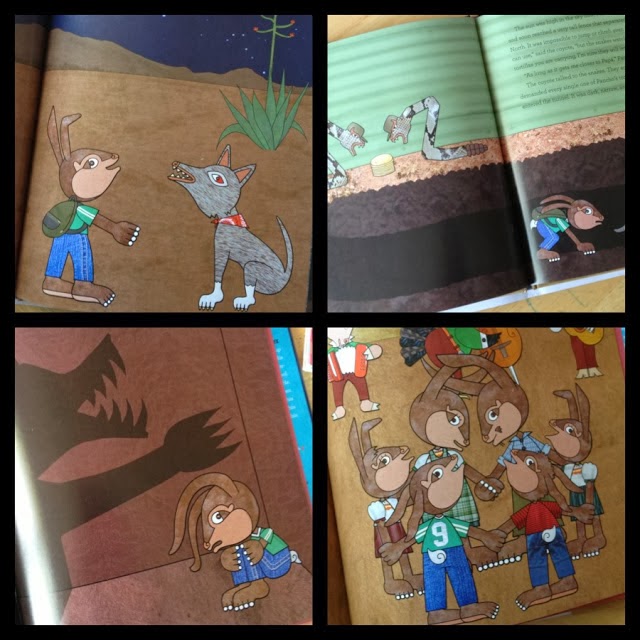
Published in 2013, Pancho Rabbit and the Coyote: A Migrant's Tale was written and illustrated by Duncan Tonatiuh. It is a 2014 Author Honor book of the Pura Belpre award. Tonatiuh himself was born in Mexico City and grew up in San Miguel de Allende, Mexico. This book beautifully represents the Mexican culture.

The story is about a family of rabbits who live in Mexico. Papa Rabbit and a few other animals left two years ago to go north for work to support their families. After the father is gone for quite a long time and misses his coming home party, Panco Rabbit decides to go searching for his father and brings his favorite meal: mole, rice and beans, warm tortillas, and fresh aguamiel. However on his journey he runs into Senor Coyote who says he will show Pancho the short cut if he gives him some of his mole. Desperate to see his father, Pancho agrees and leaves with the coyote. On their journey, Pancho and the Coyote endure many dangerous situations such as riding on top of a train, swimming across the river, and crawling through tunnels guarded by snakes. To get past each challenge, the coyote requests more and more of Pancho's meal for his father which he sadly gives up in desperation. By the time they finally reach "El Norte," Senor Coyote asks Pancho for more of his food but Pancho says he has taken it all and there is none left. "In that case, I will roast you in the fire and eat you!" Pancho (and the reader) are terrified but just when we thought all was lost, Papa Rabbit bursts through the door, scares off Coyote and saves Pancho! The boys return home to Mexico and the family agrees that next time they all will travel together.

There is a great deal of Spanish vocabulary in this book which really adds to the Hispanic theme.The definition of each word in English can be found conveniently in the Glossary in the back of the book. The author's note is absolutely fascinating. Tonatiuh goes into extensive detail about the symbolism and background information for the book. He also discusses his personal history growing up in Mexico and goes into detail about illegal immigration in the United States. He explains a number of fascinating points:

"In Spanish the word coyote has two meanings. It is the name of an animal, but it is also slang for a person who smuggles people between the U.S. and Mexican border."

"When they [his friends] returned to Mexico they told stories about eating snake when they ran out of food while crossing the desert, or of waiting for days in a shanty house in a border town for the coyote to show up."

"Furthermore, there are an estimated 1.5 million undocumented children in the U.S. and according to a 2011 Pew Hispanic Center report, in 2008 there were 5.5 million children of illegal immigrants in U.S. schools. I think that a lot of those children will relate to Pancho Rabbit." 

Isn't this the point of diverse children's literature? To have all children represented in books they can read? Reading this Author's Note adds a whole new level of understanding to the text. I don't think the text would be as meaningful and beautiful without hearing his story. The illustrations are equally heart warming. The background colors are duller with a lot of browns, oranges, and shades of the desert. The characters are in brighter colors of blues, greens, reds, and oranges. The earthy toned background with the contrast of bright characters is stunning. Tonatiuh explained on the Glossary page that he first hand drew the pictures and then collaged them digitally. They definitely represent the Mexican culture beautifully and perfectly fit with the story. Portraying the characters as cute animals is more child friendly for such a serious topic as illegal immigration. I know that my second graders will love this book and appreciate the background history. I cannot wait to share it with them!


Sunday, February 16, 2014

Glass Slipper Gold Sandal: A Worldwide Cinderella


                Glass Slipper, Gold Sandal: A Worldwide Cinderella was published in 2007. It was written by Paul Fleischman and illustrated by Julie Paschkis. Fleischman tells the traditional Cinderella story with elements and variations from all over the world. It is beautifully illustrated and the way Fleischman intertwines so many different versions of Cinderella into one is truly brilliant.

The story begins with a little girl sitting on her mother’s lap while reading a book. The cover of the book looks suspiciously similar to Glass Slipper, Gold Sandal’s cover. We can assume that the mother is reading this same Cinderella story to her daughter. This Cinderella story follows the usual progression where Cinderella’s father marries a new woman with two daughters. The woman begins to treat Cinderella badly and makes her do all of the house work. She does not allow her much food to eat and she has no bed to sleep in. The part I found most different from any other version of Cinderella that I have heard before was when the animals and fairy gave her food to eat so she could be healthy. This of course made the stepmother even angrier and she gave Cinderella more chores and work to do. Then one day the stepmother and stepsisters leave to see the Great King in hopes of being his next queen. Cinderella desperately wanted to go also but was stuck at home doing the chores she was left to do. Then, a witch (not a fairy godmother) arrived to cast a spell on the cleaning supplies to clean themselves. As Cinderella tried to find something to wear, the animals and trees around her provided her with a beautiful kimono. My favorite line in the book was when Cinderella received her shoes:

“And on the girl’s feet appeared a pair of glass slippers… diamond anklets… sandals of gold.”

It perfectly encompasses the diversity of this story and the world. Next Cinderella gets her coach thanks to her now Aunty, and arrives at palace. She shocks everyone with her beauty and mysteriousness and the (now Prince) must dance with her at once. While they are dancing Cinderella remembers she needs to leave and when the Prince tries to grab her, her instead takes off her shoe. The ending is similar to most Cinderella stories where he goes searching for the woman who owned the shoe. On the Laos page, when he arrives at the stepmother’s house, the stepmother wraps up Cinderella in a mat and hides her. The shoe doesn’t fit any of the girls and just when he is about to leave a rooster tells him that the beauty is hidden down below. Alas, the shoe fits and they live happily ever after. The story comes full circle with the same mother and little girl in the beginning. On the last page, the mother and daughter are closing the Glass Slipper, Gold Sandal book with smiles on their faces.

                Talk about a multicultural book! The countries represented in this book are Mexico, West Indies, Ireland, France, Germany, Poland, Russia, Iraq, Zimbabwe, Iran, India, China, Laos, Indonesia, Korea, Japan, and the Appalachia region of the United States. Each section of the page where text from that country is presented, the images and colors also reflect that country’s culture. I love that on the end papers there is a folk-art looking world map that labels all the places in the world featured in this book. It is like Fleischman was giving the reader a preview of all the places they were going to get to visit! My students would love to read this book and put their map skills to good use. On each page, the illustrations and text are bordered separately in color which closes us off from the story. Then the background behind the illustrations are one color and pattern whereas the page background is a contrasting bright color and different pattern. The images themselves, the background patterns, and the text, each tell their own story and yet work together to tell the same one. The illustrations promote visual literacy brilliantly. This book has a Victorian feel to it. The illustrations remind me of the beginning of Disney’s Beauty and the Beast movie because of the folk/Victorian feel and extremely bright, contrasting colors.

I believe this book will be a bit overwhelming for my second graders. They will enjoy the illustrations and the fact that it is a Cinderella story molded from variations around the world; but I think they will have a hard time following the connections between countries and the variations in the story itself. It may be difficult for them to comprehend with so many aspects changing constantly to show tribute to the various countries represented. But I would definitely use this story to help teach the story elements. I think the most beautiful thing about this book is that it celebrates all versions of Cinderella and that there is no right or wrong tale of the story. They just are all different.


Sunday, February 9, 2014

Niño Wrestles the World

Nino Wrestles the World by Yuyi Morales is one of a kind. It was published in 2013 and won the Pura Belpre Illustrator award for 2014. It celebrates the Spanish American heritage in an adorable children’s story. This book is about Nino; the lucha libre mini-wrestler in his undies that takes down all competition! The story begins on the inside of the front cover where we are introduced to Nino's competitors. The energy of this book is loud and proud! The coloring is bright with mostly shades of red, blue, and yellow.

I cannot express the level of happiness I feel when I read this book. The energy is so positive and playful. The book begins with Nino playing with his toys in his bedroom when suddenly, the Nino wrestling show begins! Nino puts on his red mask and wrestles his enemies until he wins. He always wins! That is, until his two little sisters wake up and become his next competitors… to which he is no match! It is a sweet ending to an even more adorable book. The “fight scenes” are reminiscent of comic book style but even more fun! The book is filled with simple words in Spanish and the hectic lucha libre wrestling madness that normally ensues. On the last page, Morales explains lucha libre in more detail for the readers.


It was refreshing to read a book with Latino characters  and Spanish! This book is sure to be a hit with my second graders; especially the boys. You do not need to know anything about lucha libre wrestling to be a lover of this book. It will surely touch your heart! I am embarrassed to say I have not exposed my second graders to enough Latino/Latina literature. It is difficult to find! This book will now belong in my classroom library for all of my students to read. If you end up LOVING this book as much as myself and want more, check out Danielle Davis' blog for creative craft ideas that relate to the story. Enjoy!


Let's Talk About Race


“I am a story. So are you. So is everyone.” Published in 2005, Let’s Talk About Race written by Julius Lester and illustrated by Karen Barbour is the perfect picture book for introducing and discussing the topic of race with children.  It demonstrates a message of celebrating racial diversity and equality. Topics of diversity have always been a sensitive subject for teachers. We are living in a very sensitive country, and yet now is also the time to push the boundaries of what we have been previously taught of race. I believe this book, and others like it, are the tools teachers need to execute diversity education in their classrooms.

This book is from the first person perspective of the author, Julius Lester. He begins by telling the reader that everyone has a story. He begins telling the story of his life and asks the reader to reflect on their own. Lester goes on to introduce himself in a child-friendly manner by explaining his parents, family, and favorite things. The last thing he explains to the reader about himself is his race. Not because race isn’t important; but because it is not the most important aspect himself. Lester goes on to explain that all people, of all races, all over the world have their own story and no race, gender, or socioeconomic status is better than the other. The way Lester explains the message of equality to children is remarkable. He is able to simplify such controversial and complicated topics to ensure children understand right from wrong. Lastly, Lester teaches the important lesson of equality through a small experiment the children get to try. He tells the reader to touch the bone under their eye and to touch that same place on another person. He then says, “Beneath everyone’s skin are the same hard bones.” How can anyone argue with that? What a brilliant sentence! 

“Those who say, ‘MY RACE IS BETTER THAN YOUR RACE' are telling a story that is not true.” This line stuck out to me while reading this text for the first time. I hear echoes of my students saying to each other, “My (fill in the blank) is better than yours.” He puts this timeless, childhood argument to rest by saying, “…it is a story that is not true.” I hope to read this text to my students next week and I am so excited to gauge their reactions!


The illustrations in this book are absolutely beautiful. Barbour uses so many bright COLORS, COLORS, COLORS! As she should, for this book is about celebrating the many racial and ethnic colors in the world. This book would not have as effective of a message if the illustrations were black and white or dull shades of color. The artwork immediately reminded me of Picasso’s artwork with the vibrant colors and resemblance of cubism. I don’t think there could have been a better illustrator for this book. Barbour’s illustrations are child-like and yet serious enough to convey the gravity of the message. Her use of color, line and repeated illustrations tell a story all on their own. Who are all of the people and animals in the pictures? What are their stories? I tried to pick a favorite illustration to discuss here but I can’t choose just one.
As a teacher myself, I will admit that discussing race with my students used to make me uncomfortable when I first started teaching. Who was I to discuss such a sensitive topic? Would I get in trouble with my administration or by parents? There can be so much baggage that comes with discussions such as these even though there shouldn’t be. But then one day during my first year of teaching, a little boy in my class held his forearm next to his friend’s and asked me, “Why is my skin darker than hers?” That’s when I realized I was doing a disservice to my students by not formally and even informally discussing the topic of race. I decided then that I was no longer going to tip toe around it and instead face it head on and hand in hand with my students. Now, I read as many culturally diverse books to my students as I can. We openly discuss our races, culture, heritage, and how our differences make us unique. After all, the children are our future. What are we teaching them by not celebrating what is unique about us?

 Let’s Talk About Race teaches children an imperative lesson about equality and kindness for all. And so, fellow bloggers, I leave you with the monumental question that Julius Lester asks of his readers at the end of his book. “I’ll take off my skin. Will you take off yours?”


Faith

Faith by Maya Ajmera, Magda Nakassis, and Cynthi Pon celebrates religions all over the world. Published in 2009, Faith is compiled of real, fascinating photographs of authentic people around the globe. This book is a wonderful introductory text to religious diversity for children. The background color changes to a new solid color with the turn of each page and the photographs are brightly colored too. The text of the book is large and is not too difficult for young readers. Captions accompany the photographs very clearly. Faith discusses all types of religions like Rastafarian, Buddhism, Judaism, Islam, and others. It gives brief descriptions of the different ways that religions celebrate their faith, their holidays, and their customs. The photographs feature children of races and religions all over the world.

I love the use of photographs as the cover, front matter, and back cover. This book would be helpful for teaching nonfiction text features. After the main body of the book, there is a world map that labels each country that features a child in the book. How INCREDIBLE is that?! My students would love to put their map skills to use and see where in the world these children are from.  The “Elements of Faith” section in the back of the book reviews the general aspects of religion in greater detail that in the first half of the book. It goes into detail about prayer, chanting, singing, holy books, listening, cleansing, holy places, and more.  That would be very helpful for younger students, especially for those that have not had any experiences with religion. Then the “Words to Know” section afterward would surely prove to be very helpful for children expanding their vocabulary. It acts as a general glossary for the religious vocabulary in the book.

Religion is another sensitive subject in the world today and especially in schools. We try to keep a separation between church and state. But that does not mean that children should not be exposed to the diversity of religions in the world so long as the teacher shows no bias. I am excited to read this text to my class of second graders. I think they will enjoy the book because my class is always fascinated with the customs of others. My one negative criticism of the book is that there seems to be a lot going on within the pages. My eyes had a hard time figuring out where to look first because of the organization of text and photographs and I worry my students may as well.

I purchased my own copy of Faith for my classroom for a few reasons. It teaches children a simple, friendly, unbiased message about the various religions available to them. Also, it teaches the message that people are people no matter their religion.  Lastly, it has an underlying message of good values in all religions and parts of the world:

“We respect others, making friends and building peace. We give to others, and we help those in need. Most of all, we hope.”


After all, if we do not have faith and hope, what DO we have?